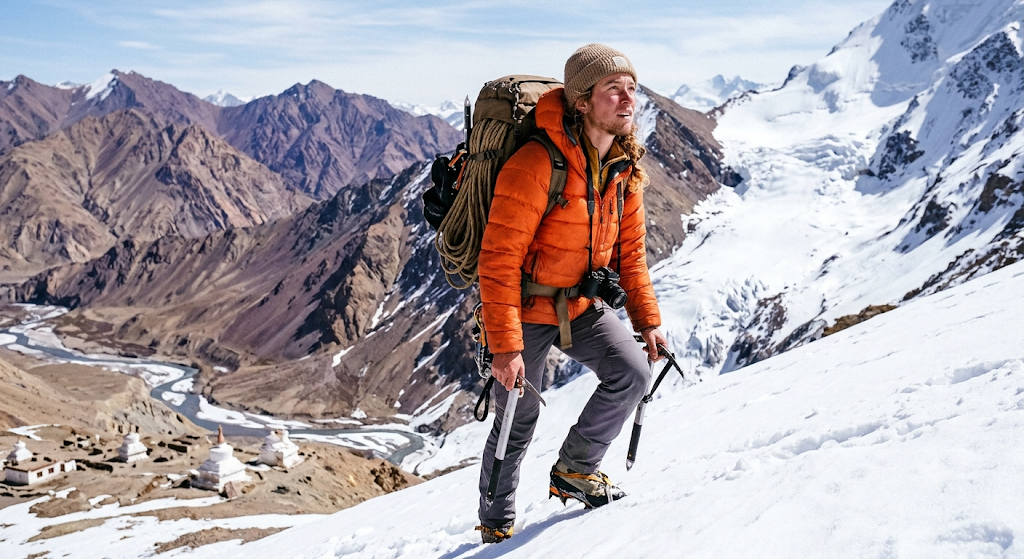
🏔️ Beyond ashrams and beaches, India holds some of the most intense and relatively uncrowded adventure terrain on the planet. The high Himalayas, glacial rivers, remote caves, and coastal wind corridors deliver serious thrills for experienced travelers. This guide covers the major destinations, key routes, seasons, permits, gear notes, and safety essentials so you can plan with clear expectations.
🧭 Adventure | 📅 Best window |
|---|---|
Ladakh motorbiking | June to September |
Spiti Valley & Pin Parvati Circuit | July to September |
Chadar Frozen River Trek | January to February |
Gulmarg | Mid-December to March |
Auli | January to March |
Rishikesh & the Ganges | October to May |
Canyoning in the Western Ghats | October to February |
Bir Billing | October–November and March–May |
Meghalaya caving | November to March |
Scuba diving in the Andamans | October–May |
🏍️1. High-Altitude Motorbiking & Overland Expeditions
The Trans-Himalayan plateau has some of the highest paved and dirt passes in the world. These rides demand solid off-road skills, physical stamina, and proper acclimatization.
🏞️ Ladakh: The classic high-pass circuit
Core experiences include riding Khardung La (17,582 ft / 5,359 m) and Umling La (19,024 ft / 5,798 m).
📅 Best window: June to September, once heavy winter snow clears.🛣️ Key routes:
- Leh – Nubra Valley – Pangong Tso: Crosses Khardung La into the cold-desert dunes of Nubra, then follows the Shyok riverbed to Pangong Lake.
- Hanle to Umling La circuit: High-altitude dirt riding near the Indo-Tibetan border.
🥾2. Remote High-Altitude Trekking & Mountaineering
Himalayan trekking in India ranges from multi-day cold-desert crossings to technical 6,000 m+ summits.
🌄 Spiti Valley & Pin Parvati Circuit (Himachal Pradesh)
Core experiences are multi-day wilderness traverses linking green valleys with arid high plateaus. Plan with Himachal Pradesh Tourism.
🧗 Top routes:
- Pin Parvati Pass Trek: Roughly 110 km over 11 days from the Kullu Valley into Spiti across a 5,319 m pass.
- Kanamo Peak Trek: Summit climb to 5,974 m near Kibber village.
- Parang La Trek: Historic trade route from Spiti to Tso Moriri Lake in Ladakh over a 5,580 m pass.
🏔️ Technical peak expeditions (6,000 m+)
- Kang Yatse II (6,200 m, Ladakh): Semi-technical summit in the Markha Valley that requires crampons, ice axes, and roped glacier travel.
- Stok Kangri (6,153 m, Ladakh): Non-technical, non-glaciated trekking peak with strong Karakoram views. Always verify current LAHDC environmental status before booking—access has been restricted at times.
🌲 Uttarakhand trails
- Roopkund Trek: High glacial trail to a famous high-altitude tarn.
- Kedarkantha and Har Ki Dun: Solid winter snow treks with views of the Swargarohini massif. These are more accessible options when full expedition logistics feel too heavy.
Explore more at Uttarakhand Tourism.
❄️3. Extreme Winter Expeditions: Ice Treks & Backcountry Skiing
Winter opens frozen rivers and deep-powder terrain.
🧊 Chadar Frozen River Trek (Ladakh)
Walk the frozen surface of the Zanskar River inside a deep canyon. Night temperatures commonly drop to –25 °C to –30 °C.
📅 Best window: January to February.📏 Distance and elevation: Roughly 105 km round-trip between about 3,300 m and 3,500 m.
⛷️ Gulmarg (Jammu & Kashmir)
Powder skiing and snowboarding accessed by the Gulmarg Gondola (Phase 2 reaches Mt. Afarwat at 3,980 m).
📅 Best window: Mid-December to March.🚣4. White-Water Rafting, Expedition Kayaking & Canyoning
Glacial rivers create sustained Class III–V whitewater.
🌊 Rishikesh & the Ganges (Uttarakhand)
Options range from short commercial runs to technical multi-stretch days.
📅 Best window: October to May (river usually closed July–August during monsoon).🗺️ Key stretches:
- Shivpuri to Rishikesh (16 km, Class II–III)
- Marine Drive (24 km, Class III+)
- Kaudiyala to Rishikesh (36 km, Class IV, including “The Wall”)
🛶 Longer river expeditions
- Zanskar River (Ladakh): 4- to 12-day self-supported runs through the Zanskar Gorge (Class III–IV+, around 3,500 m elevation, July–August).
- Tons River (Uttarakhand): High-volume Class IV–V kayaking from Mori to Tiuni (April–May and October).
- Siang and Subansiri Rivers (Arunachal Pradesh): Multi-day Class IV–V trips through remote Eastern Himalayan rainforest gorges (November–March).
💦 Canyoning in the Western Ghats (Goa & Maharashtra)
Waterfall rappelling, cliff jumps, and stream tracking near Dudhsagar Falls and Netravali in the Sahyadri range.
📅 Best window: October to February.🪂5. Aerial & Subterranean Adventures
🪁 Bir Billing (Himachal Pradesh)
One of the world’s highest paragliding take-off sites (launch around 2,400 m). Strong thermals support long cross-country flights.
📅 Best windows: October–November (strongest thermals) and March–May.🦇 Meghalaya caving
Limestone river caves and deep systems in the Jaintia and Khasi Hills, including Krem Liat Prah and Krem Mawmluh.
📅 Best window: November to March (caves flood completely during the May–September monsoon).🚵6. High-Altitude Mountain Biking & Coastal Water Sports
🚴 High-altitude MTB (Himachal & Ladakh)
- Manali to Leh: Approximately 475 km crossing five passes above 4,000 m on a mix of dirt roads and singletrack.
- Spiti and Kangra Valley routes: Technical singletrack around Bir Billing and steep cold-desert descents from Kunzum La.
🏕️ Eastern Himalayan treks (Sikkim)
Goecha La Trek: Roughly 90 km circuit reaching 4,940 m with direct views of the southeast face of Kangchenjunga (8,586 m).
🏖️ Coastal options
- Kitesurfing at Rameshwaram (Tamil Nadu): Flat-water lagoon conditions driven by consistent thermal trade winds (strongest May–September and December–March).
- Scuba diving in the Andamans (Havelock and Neil Islands): Offshore pinnacles and wrecks such as Dixon’s Pinnacle and SS Jacques, with visibility often reaching 30 m (best October–May).
🧳Essential Advice for Foreign Travelers
🫁 Acute Mountain Sickness (AMS)
💧 Drink 4–5 liters of fluid daily. 💊 Discuss acetazolamide (Diamox) with your doctor before travel. 🚁 Confirm that your insurance explicitly covers high-altitude search-and-rescue and helicopter evacuation up to 6,000 m—standard policies often exclude this.
🛂 Visas, permits & connectivity
Border regions (Ladakh, Sikkim, Arunachal Pradesh, parts of Spiti) require RAP/PAP or ILP. Process these early through registered Indian operators. Official Indian visa portal.
🎒 Equipment & legal restrictions
Bring technical gear from home—high-altitude sleeping bags rated to –20 °C or lower, fitted mountain-bike helmets, avalanche safety kits, and specialized kayak equipment—because quality rentals are limited outside major hubs.
🇮🇳 India rewards careful preparation. Choose operators with proven high-altitude experience, respect permit and medical requirements, and build in buffer days for weather and acclimatization. The terrain is genuine wilderness; treat it with the respect it demands and you will come away with some of the strongest adventure experiences available anywhere.