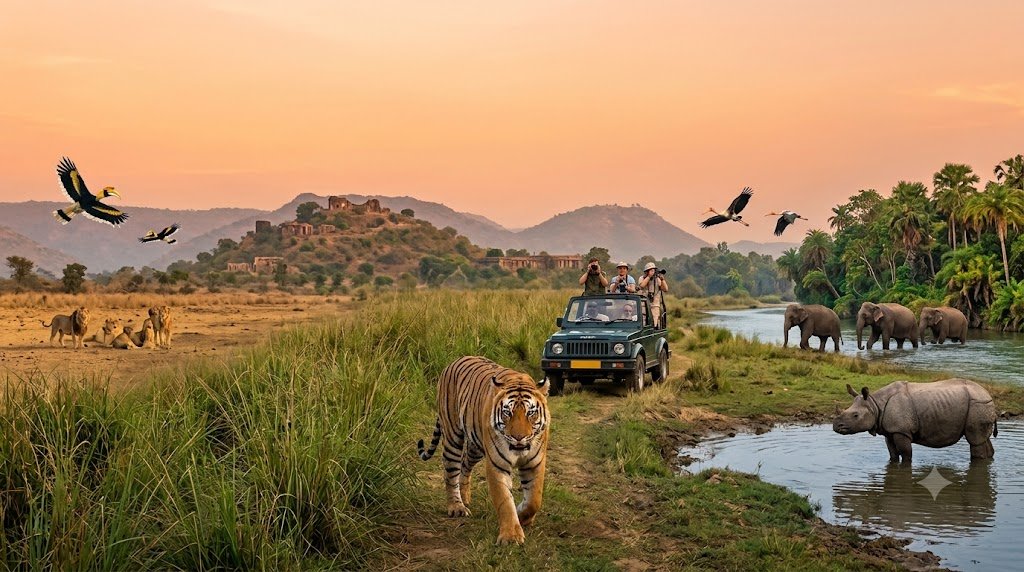
🐅 India holds roughly 8% of the world’s biodiversity across more than 100 national parks and 500+ wildlife sanctuaries. From Himalayan high altitudes to Kerala’s tropical forests and the teak woodlands of Central India, the country offers some of the planet’s most rewarding big-cat and megafauna experiences.
🧭 This guide is written specifically for foreign travelers. It covers where to go, how the permit and zoning system actually works, where you can (and cannot) stay, booking realities, ethics, and the practical details that prevent common mistakes.
🗺️ 1. India’s Core Wildlife Regions
Treat India as four distinct wildlife zones rather than one continuous ecosystem.
🐯 Central India – The Heart of Tiger Country
🌲 Key parks: Bandhavgarh, Kanha, Pench, Tadoba-Andhari, Satpura (Madhya Pradesh and Maharashtra).
🍃 Landscape: Dry deciduous forests, vast teak and sal stands, open meadows.
🐾 Signature species: Bengal tiger, Indian leopard, sloth bear, dhole (wild dog), barasingha (swamp deer).
⭐ Why go: Highest probability of tiger sightings in India. Satpura stands out because it allows walking safaris, canoeing, and limited night drives — activities rare or banned in most other core tiger reserves.
🏔️ Northern & Himalayan Region – Mountains and Valleys
🌲 Key parks: Jim Corbett (Uttarakhand), Ranthambore (Rajasthan), Hemis (Ladakh).
🍃 Landscape: Sal forests in the sub-Himalayan foothills, arid thorn scrub, and high-altitude alpine desert.
🐾 Signature species: Snow leopard, Asian elephant, Bengal tiger, Asiatic black bear, blue sheep (bharal).
⭐ Why go: Hemis is the premier place in the world for winter snow leopard tracking (“Ghost of the Mountains”). Corbett, India’s oldest national park, is excellent for elephant herds along the Ramganga River. Ranthambore combines fort ruins with tiger habitat.
🦏 North-East & Eastern India – Wetlands & Unique Ecosystems
🌲 Key parks: Kaziranga and Manas (Assam), Sundarbans (West Bengal).
🍃 Landscape: Brahmaputra floodplains, tall elephant grass, and the world’s largest mangrove forest.
🐾 Signature species: Great one-horned rhinoceros, wild water buffalo, swimming-adapted Bengal tiger, capped langur.
⭐ Why go: Kaziranga holds roughly two-thirds of the global population of one-horned rhinos. Sundarbans is boat-only and offers a completely different, tidal mangrove experience.
🦁 Western & Southern India – Rainforests & Endemics
🌲 Key parks: Sasan Gir (Gujarat), Nagarhole & Bandipur (Karnataka), Periyar and Silent Valley (Kerala).
🍃 Landscape: Dry scrub in the west; dense evergreen tropical rainforest in the Western Ghats (a UNESCO Biodiversity Hotspot).
🐾 Signature species: Asiatic lion (Gir is its only wild habitat on Earth), Malabar giant squirrel, Nilgiri tahr, lion-tailed macaque, Asian elephant.
⭐ Why go: Gir is the sole place to see Asiatic lions in the wild. The Western Ghats parks deliver high biodiversity density and excellent birding alongside the big mammals.
🎯 2. The Zoning System & How Tracking Works
Understanding core vs. buffer zones and how tracking actually happens will prevent disappointment.
🧭 Core vs. Buffer Zones
🌳 Core zones
Core zones are strictly protected forest with limited vehicle numbers. Sightings of major predators are generally higher, but permits sell out months ahead.
🏘️ Buffer zones
Buffer zones surround the cores. Indigenous communities live here alongside wildlife. Do not dismiss them — tigers, leopards, and other predators regularly move between core and buffer. Night drives (usually allowed only in buffers) produce some of the most interesting sightings: sloth bears, leopards, and occasionally pangolins.
🚫 Zone-Restricted Permits
In parks such as Ranthambore, Tadoba, and Corbett, your permit locks you into one specific zone for that drive. You cannot switch mid-safari. Booking a mix of different core zones across 3–4 days meaningfully raises your overall sighting chances.
📡 How Tracking Works
Radio telemetry and continuous radio chatter are banned in core zones. Guides and drivers rely on natural alarm calls: the sharp bark of chital (spotted deer), the whistle of sambar, and the warning calls of langurs high in the canopy. Experienced naturalists read these sounds and the direction of bird alarm to locate big cats. This is slower and more skill-dependent than African-style radio-collared tracking, but it is the authentic Indian method.
🏕️ 3. Where to Stay: Accommodation Rules & Practical Insights
Location and ownership matter more than most first-time visitors realise.
🏨 Private Resorts & Eco-Lodges (Buffer Zones and Boundaries)
Private hotels, tented camps, and luxury eco-lodges are legally barred from operating inside core zones. They sit in buffer areas or just outside the park boundary. Properties closest to the main gates (Tala gate for Bandhavgarh, Khutwanda or Moharli for Tadoba, for example) cut morning drive times significantly. The better eco-lodges employ resident naturalists, use open 4×4 vehicles, run solar power, and ban single-use plastics.
🛖 Government Forest Rest Houses (Inside Core Zones)
Only state-owned accommodations — Forest Rest Houses managed by the Forest Department or state tourism corporations (Jungle Lodges & Resorts in Karnataka, the Dhikala complex inside Corbett, etc.) — are allowed inside core areas. Staying at Dhikala, for instance, means you wake up already inside the wilderness and avoid the morning gate queue. The trade-off is basic facilities: simple meals, intermittent electricity, and limited hot water. Many foreign visitors prioritise the immersion over luxury for at least a night or two.
✅ Choosing the Right Base
- 📸Safari-focused travellers and photographers: Core-zone Forest Rest Houses where available, or boutique buffer lodges within a 10–15 minute drive of the gate.
- 🛁Travellers who want comfort, spa facilities, or private birding trails: Higher-end private eco-lodges in the buffer forest.
🎟️ 4. Practical Logistics, Booking Hacks & Getting Around
📅 Best Time to Visit
- 🟢Most parks open October/November and close late June.
- 🔥March to May usually delivers the best sightings. Vegetation is thin and animals concentrate around remaining water sources. Daytime temperatures can hit 40–45°C, so plan for heat.
- 🌧️July–September is monsoon closure for most core tiger areas.
🎫 Safari Booking & Permit Reality
Premier parks (Kanha, Bandhavgarh, Tadoba, Ranthambore) open online booking windows 90–120 days in advance on state forestry portals (MP Online for Madhya Pradesh parks, for example). High-demand zones sell out within minutes.
🛂 Key points for foreign visitors:
- Book as early as the window opens. Foreign quota seats disappear fast.
- Passport details must match exactly. You must present the original passport used at booking. Even a single digit error results in entry refusal with no exceptions.
- Certain sensitive or border areas (parts of Ladakh, Sikkim, Andaman Islands, some North-East zones) require additional Protected Area Permits on top of your Indian e-Visa.
- If regular permits are sold out, some parks release limited “Tatkal” (last-minute) permits 24–48 hours before the safari at a higher fee.
🚙 Safari Modes
🚙 Jeep (Gypsy): Open 4×4, maximum 6 guests plus driver and guide. Best for photography and flexibility.
🚌 Canter: Open mini-bus for 16–20 people. Cheaper but noisier and less manoeuvrable.
🚤 Boat safaris: Sundarbans, Periyar, and Satpura.
🥾 Walking safaris: Restricted to designated buffer zones or specific parks such as Satpura.
✈️ Internal Travel
- 🌿Central India circuit: Fly into Nagpur (NAG) or Jabalpur (JLR). Pre-book a private SUV and driver for the 3–5 hour road legs between parks; public transport is slow and unreliable for this itinerary.
- 🦏North-East: Guwahati (GAU) for Kaziranga and Manas (3–4 hour drive).
- 🐘South: Bengaluru (BLR) or Mysuru for the Kabini–Nagarhole–Bandipur belt.
📜 5. Park Rules, Ethics, Common Pitfalls & Tourist Traps
⚠️ All state forest departments enforce rules strictly.
- 🛣️Stay on marked tracks. Off-roading is prohibited and heavily penalised.
- ♻️Zero single-use plastic in most core zones. Carry a reusable steel water bottle.
- 👕Wear neutral colours (khaki, olive, brown, tan). Avoid bright whites, yellows, reds, and strong scents.
- 🤫Keep voices low and movements calm inside the vehicle.
- 💰Tip your assigned driver and guide directly (₹300–500 each per drive is standard). This money reaches local communities.
- 🐘Elephant-back safaris, once common in Kaziranga and Corbett, are now widely discouraged by ethical operators because of welfare concerns. Prefer jeep or boat.
- 🦜Do not treat the jungle like a zoo. Expecting a tiger on every drive leads to frustration. Plan at least 4–6 drives in one park. The biodiversity payoff (1,300+ bird species, rare deer, reptiles, insects) is high even on tiger-less mornings.
- 🚩Only use official park guides allocated at the gate or trained naturalists provided by reputable lodges. Roadside “guaranteed sighting” offers are almost always scams.
- 🌫️March–May safaris are dusty. Fine dust coats camera gear and irritates lungs. Carry a buff/scarf, lens cloths, and protective wraps for equipment.
🎒 6. Packing & Health Essentials
🧳 Gear
- 🧥Clothing: Layered, breathable earth tones. Winter mornings in open vehicles can be near freezing (0–5°C); afternoons climb to 25°C or higher.
- 🔭Optics: 8×42 or 10×42 binoculars are essential. Photographers should bring 300–600 mm telephoto capability.
- 🧢Protection: High-SPF sunscreen, polarised sunglasses, broad-brimmed hat, and a dust buff.
🩺 Health
- 🦟Malaria risk exists in Central and Eastern forest belts. Consult a travel clinic about prophylaxis and use high-DEET repellent in the evenings.
- 💧Drink only bottled or properly purified water. Carry electrolytes for hot afternoon drives.
📊 7. Quick-Reference Regional Comparison
Destination / Region | Primary Target Species | Safari Style | Best Airport / Rail Hub | Terrain & Accommodation Notes |
|---|---|---|---|---|
🐯 Central Circuit (Kanha, Bandhavgarh, Pench, Tadoba, Satpura) | Bengal tiger, barasingha, sloth bear, dhole | Open 4×4 jeep, walking, canoeing | Jabalpur (JLR) / Nagpur (NAG) | Teak & sal forest, meadows. Luxury eco-lodges in buffer zones. Strongest big-cat tracking. |
🏔️ Northern Foothills & Mountains (Corbett, Ranthambore, Hemis) | Tiger, Asian elephant, snow leopard, blue sheep | Open 4×4 jeep, high-altitude trekking | Delhi (DEL), Dehradun (DED), Leh (IXL) | Riverine valleys, dry scrub, alpine desert. Core government stays available (Corbett). |
🦏 North-East Marshes (Kaziranga, Manas, Sundarbans) | One-horned rhino, wild water buffalo, tiger | Jeep, boat | Guwahati (GAU), Kolkata (CCU) | Elephant grass, wetlands, mangroves. Eco-resorts near park edges. |
🦁 Southern Rainforests & West (Nagarhole, Bandipur, Periyar, Gir) | Asiatic lion, Asian elephant, leopard, black panther | Open 4×4 jeep, boat | Diu (DIU), Rajkot (RAJ), Bengaluru (BLR) | Dry scrub (Gir) to dense evergreen canopy. River lodges and state-run properties. |
🌟 A well-planned Indian safari rewards patience and realistic expectations. Book early, respect the rules, choose your base carefully, and allow enough drives. The combination of landscape variety, species diversity, and the skill-based nature of tracking makes it one of the most distinctive wildlife experiences available to international travellers.