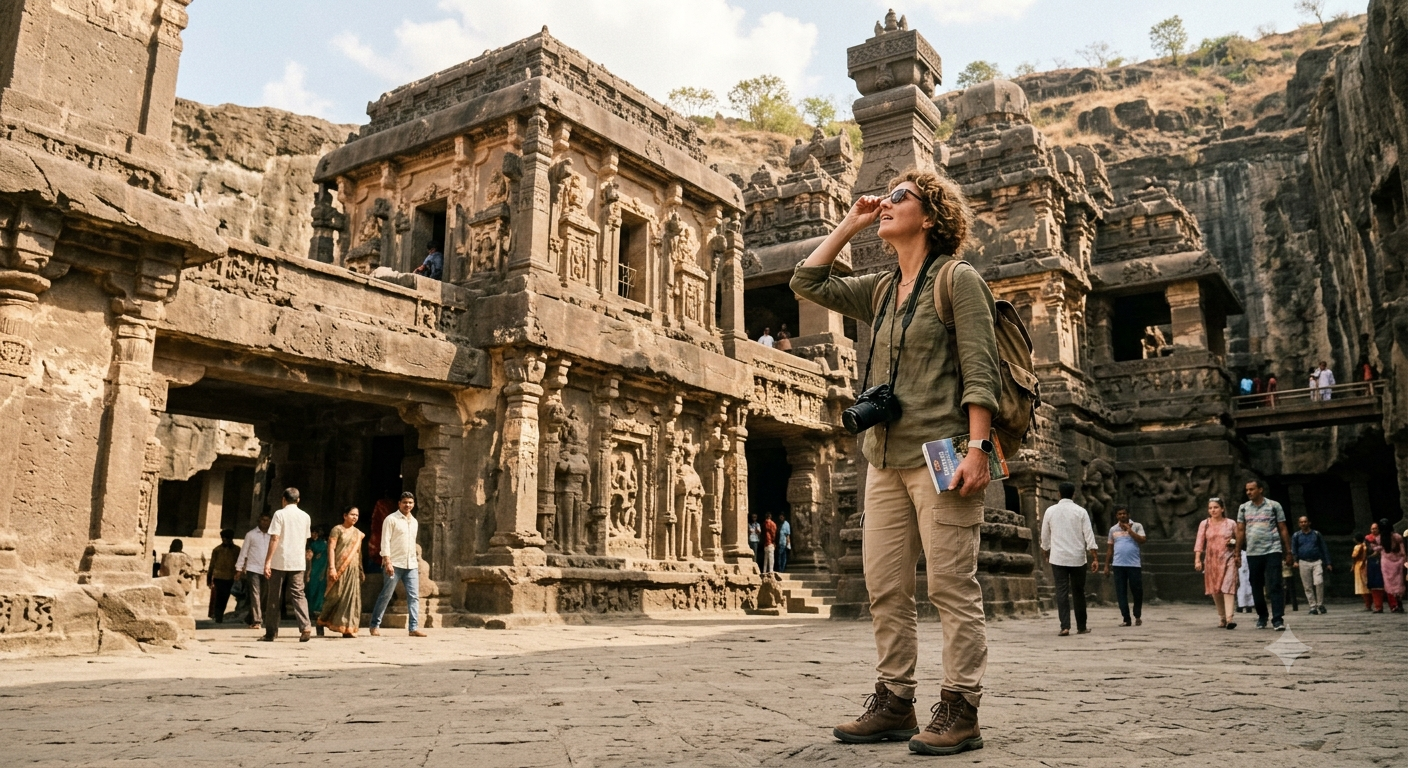
🏯 India does not keep its history in quiet museum cases. It spreads it across mountains, deserts, coastal cliffs, and river valleys. You will find it in sandstone fortresses, temples carved top-down from single mountains, subterranean stepwells, hill sanctuaries, and living temples where daily rituals have continued for centuries.
🌍 India has dozens of UNESCO World Heritage Sites and hundreds of nationally protected monuments. This guide gives international travellers a clear regional, architectural, and practical breakdown so you can plan efficiently and get real value from your time on the ground.
🏰 The North & Far North: Imperial Capitals, Desert Forts & Himalayan Foundations
North Indian architecture is shaped by two main traditions: Indo-Islamic forms (quadrangle gardens, onion domes, geometric jaali screens, red sandstone and marble inlay) and Rajput defensive engineering adapted to the Aravalli hills and desert.
🕌 The Imperial Mughal Axis: Delhi, Agra & Fatehpur Sikri
📍 Delhi (Humayun’s Tomb, Qutb Minar Complex & Red Fort)
Humayun’s Tomb (1570) is the direct precursor to the Taj Mahal and the first clear example in India of a Persian-style Charbagh (four-quadrant garden representing paradise). The Qutb Minar Complex shows the early Indo-Islamic transition: a 73-metre sandstone minaret stands beside a 4th-century CE iron pillar that has remained rust-resistant for centuries. The Red Fort (Lal Qila) shows peak Mughal court architecture with marble pavilions such as the Diwan-i-Khas and intricate floral stone inlay.
📍 Agra & Fatehpur Sikri (Uttar Pradesh)
The Taj Mahal is the high point of pietra dura (or parchin kari): semi-precious stones such as lapis lazuli, onyx and carnelian set into white Makrana marble with extreme precision. Nearby Fatehpur Sikri, Akbar’s short-lived red-sandstone capital, mixes Hindu, Jain and Persian motifs. Look for the central pillar in the Diwan-i-Khas that spreads outward like a lotus tree. Agra Fort shows the shift from Akbar’s solid red-sandstone defensive walls to Shah Jahan’s more refined white-marble private quarters.
🏯 The Six Hill Forts of Rajasthan (Jaipur, Kumbhalgarh, Chittorgarh, Jaisalmer, Amber, Gagron)
These form a collective UNESCO site. They adapt tightly to the terrain.
- 🔹 Chittorgarh covers more than 700 acres on a plateau.
- 🔹 Kumbhalgarh has a 36-kilometre perimeter wall (second in length only to the Great Wall of China).
- 🔹 Jaisalmer is a “living fort” with thousands of residents still inside its yellow sandstone walls.
- 🔹 Amber Fort combines Rajput-Mughal luxury with mirror-work halls (Sheesh Mahal).
- 🔹 Gagron is a rare water-protected fort, surrounded by rivers on three sides.
🧘 Monastic Sites & Himalayan Heritage
📍 Archaeological Site of Nalanda Mahavihara (Bihar)
From the 5th to the 12th century CE, Nalanda was one of the world’s earliest residential universities. The red-brick remains include stupa complexes, monastic cells (viharas), and sophisticated water channels.
📍 The Great Stupa at Sanchi (Madhya Pradesh)
India’s oldest surviving stone structure, originally commissioned by Emperor Ashoka in the 3rd century BCE. The stone gateways (toranas) carry detailed narrative reliefs of the Jataka tales.
🚂 Mountain Railways of India (Darjeeling, Nilgiri, Kalka-Shimla)
A collective UNESCO industrial heritage site. Late 19th-century engineering features stone-arch bridges, loop tracks and tunnels cut through steep Himalayan and Western Ghat terrain. These are working heritage lines; book seats in advance during peak season.
🗿 Central & Western India: Monoliths, Stepwells & Colonial Architecture
This region is defined by structures cut directly from the rock and by coastal colonial layers.
⛰️ Ellora, Ajanta & Elephanta (Maharashtra)
🎨 Ajanta Caves
30 rock-cut Buddhist caves (2nd century BCE to 5th century CE) with tempera murals and prayer halls (chaityas).
🛕 Ellora Caves
34 rock-cut caves spanning Buddhist, Hindu and Jain traditions.
⛴️ Elephanta Caves (near Mumbai)
5th-century basalt caves dedicated to Shiva, dominated by the 20-foot Trimurti bust.
⭐ The highlight: Cave 16 at Ellora (Kailasa Temple)
Workers removed more than 200,000 tons of volcanic basalt from top to bottom, creating the largest monolithic rock-cut temple on earth.
💧 Stepwells, Sultanates & Fortified Rock Formations: Gujarat & Madhya Pradesh
💧 Rani ki Vav & Modhera (Gujarat)
Rani ki Vav (11th century) is an inverted subterranean temple built for water storage along the Saraswati River. Seven levels contain more than 500 major sculptures. Nearby, the Sun Temple at Modhera has a stepped reservoir (Surya Kund) ringed by 108 miniature shrines.
🕌 Champaner-Pavagadh Archaeological Park (Gujarat)
An intact pre-Mughal Islamic city that has not been fully excavated. Mosques such as the Jama Masjid blend Hindu craftsmanship with Islamic geometry, set against Pavagadh Hill.
🏘️ Historic City of Ahmedabad (Gujarat)
India’s first UNESCO World Heritage City. Known for its gated residential neighbourhoods (pols), wooden haveli facades, and the 16th-century Sidi Saiyyed Mosque, famous for its marble tree-of-life jaali windows.
🏰 Gwalior Fort & Rock Sculptures (Madhya Pradesh)
Mughal emperor Babur called it “the pearl among fortresses of India.” It combines 8th-century walls, the blue-tiled Man Mandir Palace, and large 15th-century Jain statues carved into the cliff faces along the approach.
🖼️ Bhimbetka Rock Shelters (Madhya Pradesh)
Natural rock shelters with prehistoric paintings more than 10,000 years old, showing early human social life from the Paleolithic period.
⛪ Churches & Convents of Old Goa
Fine examples of Manueline, Baroque and Renaissance architecture in Asia. The Basilica of Bom Jesus holds the remains of St. Francis Xavier and is built of local dark-red laterite.
🚉 Victorian Gothic urbanism: Mumbai
Chhatrapati Shivaji Terminus (CST) fuses Victorian Gothic Revival with Indian motifs (stone peacocks, lions, gargoyles). The Fort district and Marine Drive contain the world’s second-largest collection of Art Deco buildings after Miami.
🛕 The South: Monolithic Stone, Soapstone Carvings & Living Temples
Southern architecture is marked by massive granite construction, fine soapstone carving, and Dravidian temple forms—multi-tiered pyramidal gateways (gopurams) and large pillared halls.
🪨 The Sacred Ensembles of the Hoysalas & Chalukyas (Karnataka)
🌟 Belur, Halebidu & Somanathapura (Hoysala Temples)
12th–13th-century temples carved from chlorite schist (soapstone), allowing detail almost as fine as ivory work. They stand on raised star-shaped platforms (jagati) with layered friezes of elephants, lions and mythic figures.
🏛️ Group of Monuments at Pattadakal, Badami & Aihole (Karnataka)
Pattadakal was an 8th-century experimental ground where the Badami Chalukyas built northern (Nagara) and southern (Dravidian) styles side by side. Badami has red-sandstone cave temples cut into cliffs. Aihole contains more than 100 early stone temples, including the apsidal Durga Temple.
🛶 Vijayanagara Empire & Telangana Innovations
🪨 Hampi (Karnataka)
Capital of the 14th-century Vijayanagara Empire, covering 4,100 hectares of boulder landscape. Key sights include the stone chariot at Vittala Temple, royal stepwells, aqueducts and musical-pillared halls.
🧱 Kakatiya Rudreshwara / Ramappa Temple (Telangana)
13th-century temple with a “sandbox” foundation that improves earthquake resistance and lightweight “floating bricks” that reduce load on the carved granite pillars.
👏 Golconda Fort & Qutb Shahi Tombs (Hyderabad, Telangana)
Golconda is known for its acoustic engineering: a handclap at the entrance can be heard at the hilltop pavilion roughly a kilometre away. The Qutb Shahi Tombs combine Persian, Pathan and Hindu elements in bulbous-domed mausoleums.
🛕 The Great Living Chola Temples & Coastal Sanctuaries (Tamil Nadu & Puducherry)
🙏 The Living Chola Temples (Thanjavur, Darasuram, Gangaikonda Cholapuram)
Built in the 11th and 12th centuries from solid granite without mortar. The central vimana at Thanjavur rises more than 200 feet and is topped by an 80-ton single-block granite capstone. These remain active places of daily worship.
🌊 Mahabalipuram (Tamil Nadu)
7th-century Pallava rock-cut monuments on the Coromandel Coast. Includes the Shore Temple, the Five Rathas (monolithic structures shaped like wooden processional chariots), and Arjuna’s Penance (a large open-air relief across two boulders).
🎨 Meenakshi Amman Temple (Madurai, Tamil Nadu)
A major example of late Dravidian architecture with 14 soaring gopurams covered in thousands of painted figures and the “Hall of 1,000 Pillars” (Ayirakkal Mandapam).
🪵 Padmanabhapuram Palace (Tamil Nadu / Kerala border)
16th-century wooden palace complex showing traditional Kerala timber architecture: carved rosewood ceilings, polished black granite floors made with a traditional egg-white resin mix, and secret underground passages.
☀️ The East & Northeast: Chariot Temples, Terracotta & Ahom Dynasties
🐎 Sun Temple at Konark & Golden Triangle of Odisha
☀️ Sun Temple at Konark (Odisha)
13th-century Kalinga-style temple designed as a stone chariot for the Sun God Surya. It has 24 carved stone wheels (many function as sundials) and is pulled by seven stone horses.
🛕 Bhubaneswar Temple Complex (Odisha)
Known as the “Temple City.” Classic Kalinga architecture over a thousand years, led by the 11th-century Lingaraj Temple and the 10th-century Mukteshwar Temple with its distinctive stone archway (torana).
🧱 Terracotta Architecture & Ahom Burial Mounds: West Bengal & Assam
🧱 Terracotta Temples of Bishnupur (West Bengal)
17th–18th-century temples built of baked clay bricks because local stone was scarce. Facades carry detailed terracotta panels of scenes from the Ramayana and Mahabharata.
⛰️ Moidams – The Mound-Burial System of the Ahom Dynasty (Assam)
UNESCO-listed 600-year-old royal burial mounds. Earthen pyramids contain vaulted brick and stone chambers reflecting Tai-Ahom funerary traditions in the Brahmaputra Valley.
🧭 Cultural Insights, Etiquette & Practical Logistics
👣 Footwear protocol
Remove shoes, sandals and leather items before entering active Hindu, Jain and Sikh sites. Bring slip-on footwear and a pair of thick, dark socks—stone courtyards become very hot by midday.
👗 Dress expectations
Shoulders and knees must be covered at active religious sites. Keep a light cotton scarf or shawl in your bag for quick coverage.
🙏 Living vs archaeological monuments
Sites managed by the Archaeological Survey of India (ASI)—such as Fatehpur Sikri or Ellora—function mainly as historic monuments. Active temples (Chola temples, Meenakshi, Virupaksha at Hampi) are places of daily worship. Follow priest instructions and avoid interrupting ceremonies.
🎟️ ASI entry passes
Buy digital tickets in advance on the official Archaeological Survey of India portal. Foreign-tourist tickets often have separate queues at high-traffic sites such as the Taj Mahal and Agra Fort. Keep a digital or printed copy ready.
🌤️ Best travel windows
🎒 Additional practical insights for travellers
🧑🏫 Licensed guides
Hire licensed guides at major complexes; they help with context and navigation, especially at large sites like Hampi, Ellora or the Rajasthan forts.
📷 Photography
Drones are restricted or banned at most ASI and UNESCO sites. Tripods may require permission. Respect no-photo zones inside living temples.
🚆 Transport
Major circuits (Delhi–Agra–Jaipur, Aurangabad for Ajanta/Ellora, Hampi, Tamil Nadu temple trail) are well served by trains, domestic flights and hired cars. Book longer road transfers in advance during peak season.
🛡️ Conservation note
Many sites are actively conserved. Stay on marked paths, do not touch carvings, and avoid climbing on monuments.
♿ Accessibility
Surfaces are often uneven, stepped or rocky. Check individual site information if mobility is a concern; some major monuments now offer limited assistance or alternative routes.
✅ This guide covers the core architectural and historical highlights while giving you the practical details that make visits smoother and more rewarding. Use it to prioritise regions according to your time and interests, then layer in the local tips for each place. India’s heritage rewards early starts, respectful behaviour and a willingness to move beyond the single most famous monument in each area.