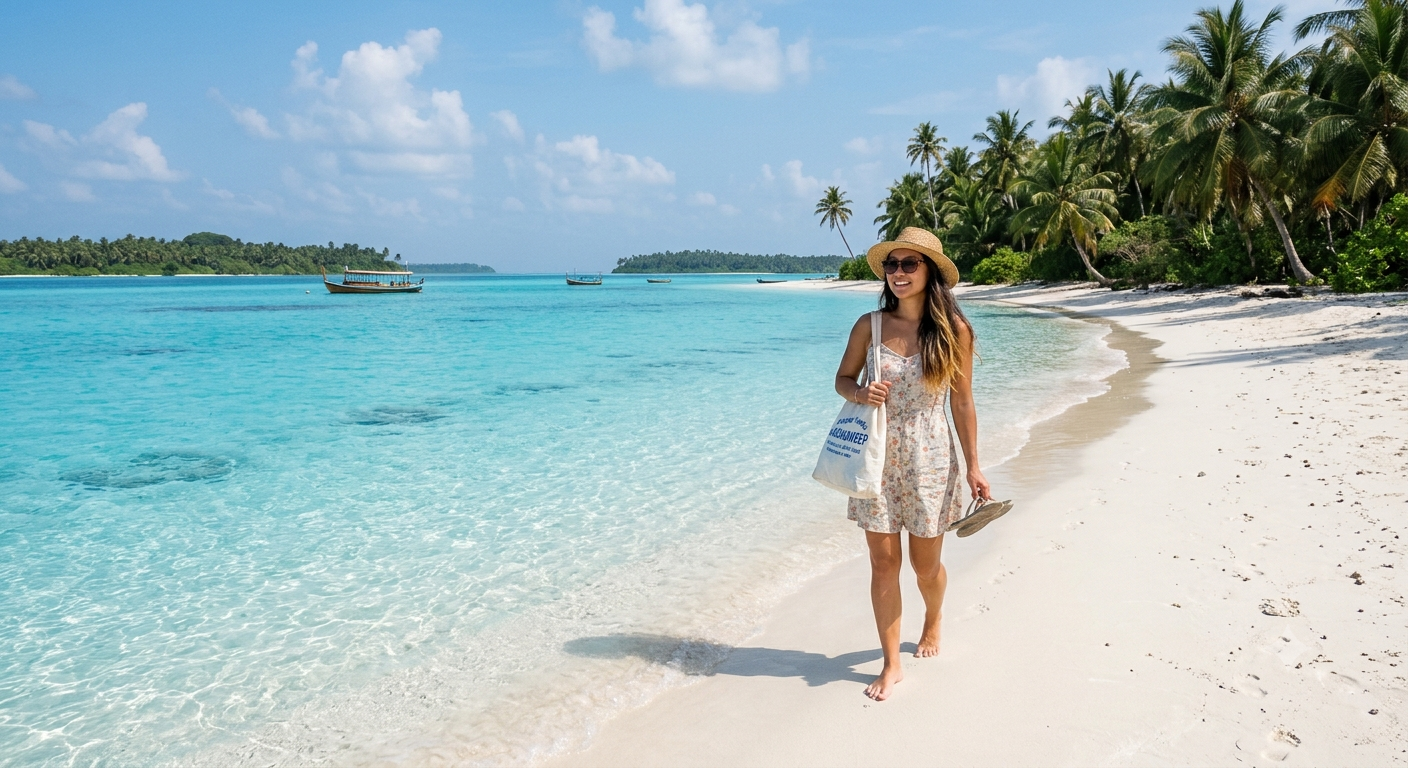
🌊 For travelers who judge a trip by underwater visibility and reef quality, India offers two distinct marine destinations far from the mainland.
The Andaman & Nicobar Islands in the Bay of Bengal and the Lakshadweep Archipelago in the Arabian Sea deliver isolation, strong diving, and healthy coral systems. This guide covers how to plan a trip to these remote islands, where most days start with a mask and snorkel and end at a quiet eco-resort. 🤿
1. The Andaman & Nicobar Islands: Jungle-Fringed Wilderness
The Andamans sit closer to Southeast Asia than to mainland India. They are the peaks of a submerged mountain range. Rainforest drops straight onto white sand beaches, then into steep drop-offs, pinnacles, and productive dive sites.
🤿 Havelock Island (Swaraj Dweep): The Diving Hub
Havelock balances decent infrastructure with relatively undeveloped coastline.
- 😎Vibe: Established, international, and relatively eco-conscious. Top dive shops, boutique resorts, and restaurants line Beach No. 5 (Vijay Nagar).
- 💙Best for: Travelers who want strong diving, comfortable accommodation, and good food options.
- 🐢Marine highlights: Dugongs in seagrass beds, oceanic reef sharks, manta rays, sea turtles, and large schools of yellowtail barracuda.
🪸 Key dive and snorkel sites
🦈 Johnny’s Gorge
Deep plateau surrounded by sand and open water. Known for pelagics, reef sharks, and rays. Advanced.
🐟 Dixon’s Pinnacle
Three rock pinnacles rising from about 30 m. Current-swept site with giant trevally, barracuda, and tuna cleaning stations. Advanced.
🐠 The Slope
Gentle gradient with soft corals, parrotfish, and giant clams. Suitable for beginners and Open Water divers.
🤿 Nemo Reef
Sheltered bay close to shore with mixed hard and soft coral. Ideal for PADI courses and first-time snorkeling.
🚲 Neil Island (Shaheed Dweep): Rustic and Macro-Focused
A short ferry ride (about 18 km) south of Havelock. Neil is flatter, more agricultural, and quieter.
- 🚲Vibe: Bicycle-friendly, slow-paced, with local homestays and quieter beaches.
- 💑Best for: Couples, solo travelers who prefer calm, and macro photographers.
- 🐢Marine highlights: Strong for macro life (nudibranchs, ghost pipefish, anemones) plus green sea turtles.
🪸 Key sites
🐠 Margherita’s Mischief
Shallow, calm area with soft coral and reef fish. Beginners.
🌀 Junction
Deeper site where currents can bring jacks and sharks. Advanced.
🪨 K-Rock
Large submerged boulder that often holds sweetlips and turtles.
🌋 Barren Island: South Asia’s Only Active Volcano
Liveaboards or day boats from Havelock reach Barren Island. Diving features black-sand drop-offs, visibility that can exceed 40 m, and regular sightings of hammerheads and mantas.
⚠️ This is for experienced divers only; conditions can change quickly around the volcano.
2. Lakshadweep: Turquoise Lagoons and Coral Atolls
Lakshadweep is a chain of low coral atolls. Each island sits inside a large, shallow lagoon protected by outer barrier reefs.
🌊 Typical atoll structure
- Open ocean
- Outer barrier reef
- Shallow turquoise lagoon
- Island
🐢 Bangaram Island: Uninhabited Eco-Isolation
Bangaram is an uninhabited teardrop-shaped island that shares a large lagoon with Thinnakara and Parali.
- 🤫Vibe: Strict permit quotas and limited infrastructure keep visitor numbers low. The feel is remote and low-impact.
- 💙Best for: Isolation, eco-luxury, honeymooners, and anyone seeking calm lagoon scenery with minimal development.
- 🐢Marine highlights: Hawksbill and green turtles nesting on beaches, manta and eagle rays in the lagoon, and relatively intact coral gardens.
- 🛶Activities: Night kayaking (bioluminescence is common in the lagoon), lagoon snorkeling, and drift diving on the outer reef.
🏖️ Kadmat & Agatti Islands
🏝️ Kadmat
Long, narrow island (about 8 km) with sandbars and shallow lagoons on both sides. Has a state-run water-sports center and accessible coral gardens.
✈️ Agatti
Gateway island with the main airstrip. Most foreign visitors clear formalities here and then transfer by speedboat or helicopter to Bangaram or Kadmat. The airstrip itself is surrounded by water on both sides.
Island Master Comparison Matrix
| Feature | Havelock (Andamans) | Neil (Andamans) | Bangaram (Lakshadweep) |
|---|---|---|---|
| ⛰️ Topography | Rainforest hills, deep bays | Flat, rural farmland | Low coral sand spit, vast lagoon |
| 🎨 Water Color | Emerald to deep sapphire | Clear teal | Electric turquoise and azure |
| 🤿 Dive Profile | Walls, deep pinnacles, pelagics | Macro sites, gentle slopes | Shallow lagoon drifts, barrier reefs |
| 🏨 Stays | Luxury eco-resorts, dive lodges | Rustic beach huts, homestays | Single luxury eco-resort footprint |
| 😌 Vibe | Social, active, dive-focused | Quiet, relaxed, slow | Total isolation, barefoot luxury |
Practical Advice, Logistics & Safety
📅 1. Seasons & Best Time to Visit
Best season (October–May): Calm seas, lower rainfall, water temperatures of 27–30°C, and good visibility.
Monsoon to avoid (June–September): Heavy rain, strong winds, and rough seas. Many dive sites reduce operations or close for safety.
🛂 2. Permits & Regulations
📝 Lakshadweep e-Permit process (simplified)
- Book a resort or official tour package.
- Apply online for the e-Permit 14–30 days ahead with passport and photo ID.
- Download the approved permit and board the flight.
- ✅
All non-residents need a Restricted Area Permit / e-Permit from the Lakshadweep Administration. It is linked to a confirmed resort booking. Police Clearance Certificates are no longer required.
- 🚫
Andaman tribal reserves: Foreign visitors no longer need a Restricted Area Permit for the main tourist islands (Havelock, Neil, Baratang). Entering tribal reserve areas used by indigenous groups such as the Jarawa or Sentinelese is illegal and strictly enforced.
- 🪸
Environmental rules: Do not touch or stand on live coral. Use only mineral-based, reef-safe sunscreen (zinc oxide or titanium dioxide). Chemical sunscreens with oxybenzone harm coral. Wear a rash guard and use waterproof cases for gear.
🩺 3. Health, Transport & Safety
Leave at least 18–24 hours between your last dive and any flight out of Port Blair or Agatti to reduce the risk of decompression sickness.
Havelock, Neil, and Agatti have basic clinics. Serious cases require evacuation to Port Blair or the mainland. The main hyperbaric chamber is at G.B. Pant Hospital in Port Blair. Dive only with licensed operators who carry emergency oxygen.
⛴️ Getting there
These two island groups give very different experiences—one focused on rainforest-backed diving with variety and infrastructure, the other on lagoon isolation and strict environmental limits. Match the destination to how much diving, solitude, and logistics complexity you want, book permits and ferries early in peak season, and treat the reefs carefully.