🕉️ In India, spirituality is not limited to quiet museums or weekly services. It is a living, everyday landscape. Rivers are treated as goddesses, mountains are seen as physical forms of deities, and ancient cities keep rituals going that have continued for thousands of years.
🌏 For international travelers, India’s pilgrimage circuits can feel like entering a different sense of time. This guide goes beyond surface impressions. It gives a practical, culturally aware, and immersive roadmap to India’s major spiritual destinations—sacred rivers, ancient temples, ashrams, and monastic communities. You will find what to expect, how to participate respectfully, and useful tips that help you experience these places more fully.
🗺️ Spiritual Ecosystem Matrix
Destination | Primary Tradition | Core Ritual / Experience |
|---|---|---|
🪔 Varanasi | Shaivite / Hindu | Ganga Aarti, ghat bathing, cycle of life & death |
🙏 Amritsar | Sikhism | Langar (free kitchen), Harmandir Sahib immersion |
🧘 Rishikesh / Haridwar | Yoga / Ascetic | Ashrams, meditation, river devotion |
⛰️ Char Dham | Himalayan Hindu | High-altitude pilgrimage trekking |
🛕 Madurai | Dravidian Shakta | Temple-town rituals, massive gopuram corridors |
🏔️ Palitana & Ranakpur | Jainism | Mountain climbs, marble non-violence sanctuaries |
☸️ Dharamshala & Ladakh | Tibetan Buddhist | Monastic chants, stupas, Himalayan retreats |
🎶 Ajmer & Delhi | Sufi Islam | Qawwali music, dargah veneration |
🌊 1. The Sacred Rivers & Ghats: Varanasi, Haridwar & Prayagraj
The northern plains are shaped by the Indo-Gangetic river system. Here water is not just a resource—it is viewed as a purifying divine presence (Tirtha, a crossing place between the earthly and the celestial).
🪔 Varanasi (Kashi, Uttar Pradesh): The Eternal City
One of the oldest continuously inhabited cities in the world, Varanasi is believed to be the city of Lord Shiva. Many Hindus hope to die here or have their ashes scattered in the Ganges to achieve Moksha (liberation from the cycle of rebirth).
✨ Key experiences:
- The Ghats & Ganga Aarti: A stretch of 84 stone riverfront steps (ghats). Every evening at Dashashwamedh Ghat, priests perform the grand Ganga Aarti—a synchronized ritual of fire, brass lamps, chanting, and incense.
- Manikarnika Ghat: The primary cremation ghat where funeral pyres burn around the clock. Foreign visitors are welcome to observe respectfully from a distance or from a boat. Photography of cremations is strictly forbidden. 📍 Map
💡 Insider tip: Take a sunrise boat ride along the ghats. Watch the city wake as thousands of pilgrims bathe in the misty river. Arrive early for a quieter experience and better light.
📝 Practical notes: The main ghats can be crowded and intense. Stay on the river side or in a boat if you prefer some distance. Early morning and evening are the most atmospheric times.
🧘 Haridwar & Rishikesh (Uttarakhand): Gateways to the Gods
Haridwar (“Gateway to God”) sits where the Ganges leaves the Himalayas and enters the plains. Har Ki Pauri is the main center. Millions come for ritual bathing (Snan). The evening Aarti here is raw, intense, and highly devotional.
Rishikesh (“World Capital of Yoga”), about 30 minutes upstream, shifts the focus from dense traditional ritual to ashrams, meditation halls, and yoga schools.
📌 Key landmarks: Parmarth Niketan Ashram (known for its calm evening Ganga Aarti often led by children and seekers) and the Beatles Ashram (Chaurasi Kutia), where the band stayed in 1968 to study transcendental meditation. The site is now open to visitors and feels peaceful and slightly overgrown.
📝 Practical notes: Haridwar is more ritual-focused and can feel intense during festivals. Rishikesh is better for longer stays if you want yoga or meditation courses. Book ashram stays or reputable yoga schools in advance during peak seasons (September–March).
🌅 Prayagraj (Triveni Sangam, Uttar Pradesh)
This is the confluence of three rivers: the visible Ganges and Yamuna, and the invisible, subterranean Saraswati. Every 12 years it hosts the Kumbh Mela, the largest peaceful gathering of people on Earth. Even in ordinary years, taking a boat to the exact point where the muddy brown Ganges meets the greenish Yamuna is a powerful experience. 📍 Map
📝 Practical notes: Boat rides to the Sangam are easy to arrange from the main ghats. During non-Kumbh years the crowds are manageable. Dress modestly and keep valuables secure in busy areas.
🙏 2. Sikh Spirituality & Radical Hospitality: Amritsar & Anandpur Sahib
✨ Amritsar (The Golden Temple / Harmandir Sahib, Punjab)
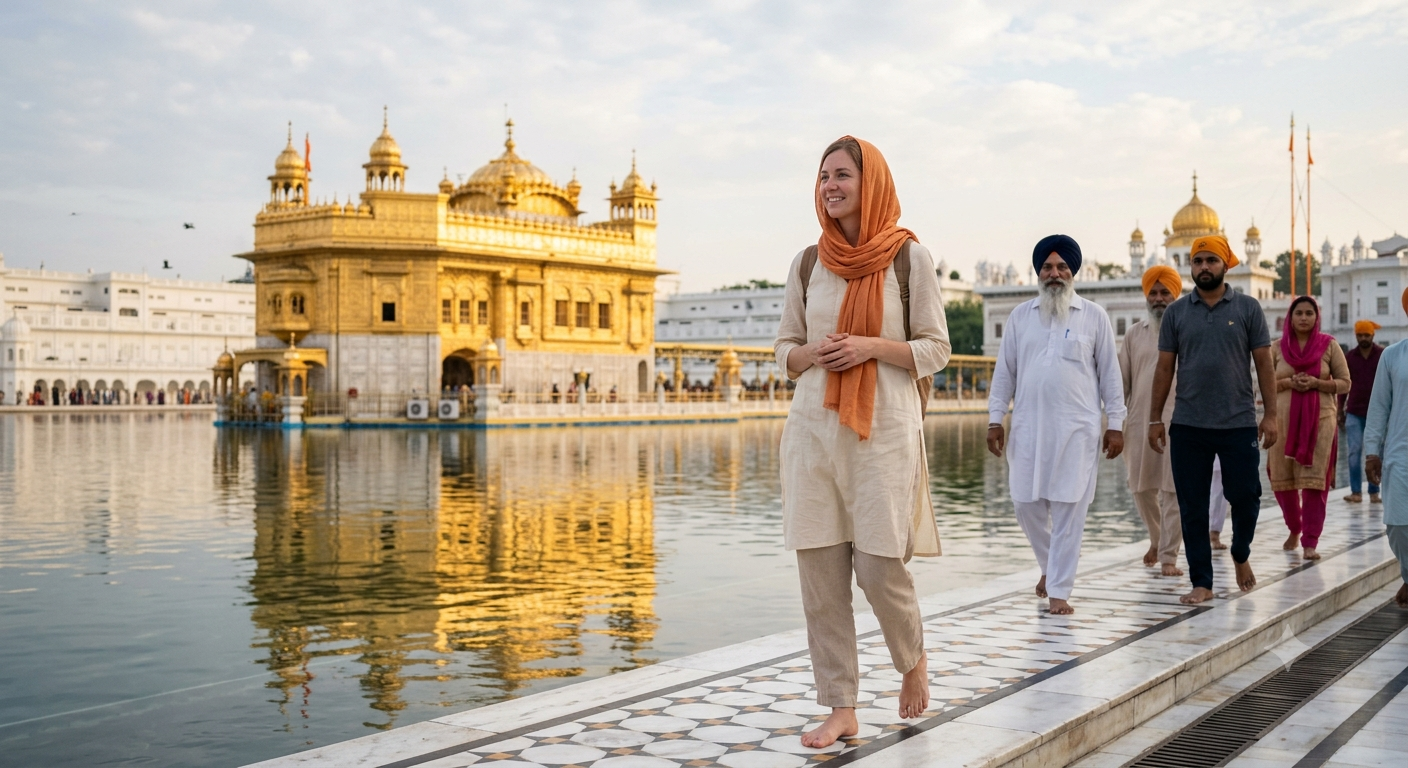
The holiest shrine of Sikhism sits in the middle of a sacred pool (Amrit Sarovar). The temple has four entrances facing the four cardinal directions, a clear statement that people of all backgrounds, races, and religions are welcome. 🌐 Official website
The building is covered in gold leaf and white marble and blends Islamic and Hindu design elements, reflecting the Sikh emphasis on universal harmony.
🍛 The world’s largest community kitchen (Langar) serves free vegetarian meals every day to 100,000–150,000 people through volunteer service (Seva). Visitors sit cross-legged on the floor in large dining halls. Participating is one of the most direct ways to experience the Sikh principle of equality.
💡 Insider tip: Arrive before dawn (around 4:00 AM) for the Palki Sahib ceremony, when the holy scripture (Guru Granth Sahib) is carried from the sanctum to its resting place with hymns.
📝 Practical notes: Cover your head (scarves are available free), remove shoes, and wash your feet at the entrance. The atmosphere is calm and highly organized. Photography is generally allowed in outer areas but restricted in certain inner spaces—follow the signs.
⚔️ Anandpur Sahib (Punjab)
This is the birthplace of the Khalsa (the collective body of initiated Sikhs) in 1699. Nestled against the Shivalik hills, it hosts the lively annual festival of Hola Mohalla, which features martial arts displays, horse-riding feats (Gatka), and devotional poetry.
📝 Practical notes: Hola Mohalla timing varies each year; check dates if you want to attend. The town is quieter outside festival periods and pairs well with a visit to Amritsar.
🏔️ 3. Jain Architecture & Purity: Palitana, Ranakpur & Shravanabelagola
Jainism places strong emphasis on non-violence (Ahimsa), asceticism, and purity. This is visible in the marble temples built on mountaintops.
🏯 Palitana (Shatrunjaya Hill, Gujarat)
More than 860 white marble temples cover Shatrunjaya Hill. Jains believe that all their Tirthankaras (spiritual teachers) except one attained liberation here.
Pilgrims and visitors climb more than 3,000 stone steps on foot, usually starting before dawn. Because the entire hill is considered sacred, no one—including priests—is allowed to stay overnight on the mountain.
💡 Insider tip: Palitana is the world’s first legally 100% vegetarian city. Wear comfortable slip-on shoes and carry water. Leather items are not permitted on the mountain.
📝 Practical notes: The climb is steep and can take 2–3 hours. Start early to avoid heat. Porters and dholis (carried chairs) are available for those who need them. Carry only essentials.
💎 Ranakpur & Mount Abu (Rajasthan)
Ranakpur Jain Temple sits in a quiet valley of the Aravalli hills. This 15th-century marble temple has 1,444 uniquely carved pillars—no two are the same.
Dilwara Temples (Mount Abu), built between the 11th and 13th centuries, feature ceiling carvings so fine that light almost passes through the marble.
📝 Practical notes: Ranakpur is best visited as a day trip or overnight stop between Udaipur and Jodhpur. Mount Abu is a cooler hill station; combine the temples with a short stay if the weather is hot elsewhere.
🗿 Shravanabelagola (Karnataka)
Home to the 57-foot-tall monolithic statue of Lord Bahubali (Gommateshwara), carved from a single granite block on Vindhyagiri Hill in 981 CE. Every 12 years the Mahamastakabhisheka festival sees the statue anointed with milk, saffron, turmeric, and sandalwood paste. 📖 Learn more
📝 Practical notes: The climb involves steps; allow time and water. The statue is most impressive in the early morning light. Check festival years if you want to witness the anointing.
☸️ 4. Tibetan Buddhist Enclaves: Dharamshala, Ladakh & Bodh Gaya
🌳 Bodh Gaya (Bihar): The Tree of Enlightenment
Mahabodhi Temple is the geographical center of Buddhism. Under the sacred Bodhi Tree (a direct descendant of the original), Prince Siddhartha attained enlightenment and became the Buddha. Monks from Sri Lanka, Thailand, Tibet, Japan and other countries pray around the perimeter in their own traditions.
📝 Practical notes: The complex is well organized. Early morning and evening are quieter. Combine with a visit to nearby monasteries if time allows.
🏞️ Dharamshala & McLeod Ganj (Himachal Pradesh)
Often called “Little Lhasa,” this is the exile home of the 14th Dalai Lama and the Tibetan Government-in-Exile. Set against the Dhauladhar mountains, McLeod Ganj offers Tibetan monasteries, meditation centers, and the Tsuglagkhang Complex (the Dalai Lama’s temple). 🌐 Dalai Lama official website
📝 Practical notes: The area is popular with long-stay visitors and has good facilities for meditation courses. Weather can change quickly; pack layers. Respect monastery rules on photography and noise.
🏔️ Ladakh (Ladakh Territory)
High mountain monasteries such as Hemis, Thiksey, and Diskit sit on cliffs above the Indus River. They host vibrant monastic festivals with masked Cham dances, butter sculptures, and chanting in high-altitude gompas.
⚠️ Practical notes: Altitude is a real factor (many sites are above 3,500 m). Acclimatize properly, stay hydrated, and avoid heavy exertion for the first 24–48 hours. Festival dates are worth checking if you want to see Cham dances.
🎶 5. Sufi Mysticism & Islamic Heritage: Ajmer & Delhi
Sufism is the mystical, devotional side of Islam, focused on love, music, and spiritual lineage at the shrines (dargahs) of revered saints.
🕌 Ajmer Sharif Dargah (Rajasthan)
The resting place of the 13th-century Sufi saint Khwaja Moinuddin Chishti. People of all backgrounds—Hindus, Muslims, Sikhs, Christians—come here to tie threads of intention on marble screens and seek blessings. 📖 Learn more
🎵 In the evenings, traditional Qawwal musicians perform in the courtyard with harmoniums, tabla, and powerful vocals.
📝 Practical notes: The complex can be crowded, especially on Thursdays and during Urs. Keep belongings secure and follow local guidance on offerings.
🌙 Nizamuddin Dargah (Delhi)
Located in dense medieval lanes, the shrine of Hazrat Nizamuddin Auliya and the poet Amir Khusrau comes alive every Thursday evening with well-known live Qawwali sessions. 📖 Learn more
📝 Practical notes: Thursday evenings are the highlight. Arrive a little early for a better spot. Dress modestly and remove shoes where required.
⛰️ 6. The Himalayan High Sanctuaries: The Char Dham & Hemkund Sahib
High-altitude pilgrimage in the Indian Himalayas has tested the physical endurance of seekers for centuries.
🛤️ The Chota Char Dham Yatra (Uttarakhand)
- 🔥 Yamunotri – Source of the Yamuna River, with natural thermal springs.
- 🌲 Gangotri – Source of the Ganges, set among pine forests and granite peaks.
- 🔱 Kedarnath – One of the 12 sacred Jyotirlingas of Lord Shiva, at 3,583 m against glacial peaks.
- 🪷 Badrinath – A temple dedicated to Lord Vishnu along the Alaknanda River near the Tibetan border.
🗓️ Logistical note: These sites are accessible only from late April/May to November. They close during heavy winter snow, when the deities are symbolically moved to lower-altitude winter residences.
📝 Practical notes: The yatra involves long road journeys and some trekking (especially Kedarnath). Register online if required, carry warm layers even in summer, and watch for altitude effects. Helicopter options exist for Kedarnath but book early.
🏔️ Hemkund Sahib (Uttarakhand)
A high-altitude Sikh sanctuary at 4,160 m beside a glacial lake. The star-shaped Gurdwara honors the 10th Sikh Guru, Guru Gobind Singh, and is surrounded by seven snow-capped peaks. 📖 Learn more
⚠️ Practical notes: The trek is demanding. Proper acclimatization, good footwear, and weather awareness are essential. The season is short—usually June to early October.
🛕 7. Southern Dravidian Temples: Sacred Mandalas & Living Cities
In South India, temples operate on a massive urban scale. They function as living models of cosmic mandalas, not just places of worship.
🌺 Madurai (Meenakshi Amman Temple, Tamil Nadu)
Dedicated to Goddess Meenakshi and Lord Sundareshwar. The complex covers 14 acres and is dominated by 14 towering, multi-colored gopurams covered in thousands of carved mythological figures. The ancient city of Madurai was planned in concentric squares radiating outward from the central temple. 🌐 Official website
📝 Practical notes: The temple is large and busy. Early morning is best for a calmer visit. Guided walks help make sense of the layout and mythology.
🌊 Rameshwaram & Tirupati
Rameshwaram (Ramanathaswamy Temple, Tamil Nadu) sits on an island at India’s southern tip. It is famous for its long pillared corridors—the longest of any Hindu temple in India—and 22 sacred freshwater wells.
Tirupati (Tirumala Venkateswara Temple, Andhra Pradesh) sits atop seven sacred hills. It is one of the most visited and wealthiest religious sites in the world, known for its tonsuring (hair donation) rituals and highly organized crowd systems.
📝 Practical notes: Both sites attract large numbers of pilgrims. Follow the official queues and token systems. Dress codes are strictly enforced. Rameshwaram pairs well with a visit to the nearby beaches and the Pamban Bridge.
🧭 8. Practical Etiquette & Cultural Nuances for Foreign Visitors
👣 Head coverings & footwear
At Sikh gurdwaras, both men and women must cover their heads (scarves are usually provided free) and remove shoes. Free shoe-keeping stands (Jora Ghar) are standard. At Hindu, Jain, and Buddhist sites, remove leather items (belts, wallets, shoes) when asked. Thick cotton socks help on hot stone floors or cold mountain temples.
👗 Modesty and dress
Wear loose, conservative clothing that covers shoulders and knees. Women should carry a lightweight cotton scarf (dupatta or shawl).
📵 Photography
Many temples prohibit photos inside the inner sanctum (Garbhagriha). Always check signs or ask before photographing. Cremation grounds and some monastic areas have strict no-photo rules.
🚫 Temple offerings and guides
Be cautious of aggressive self-appointed guides or priests near temple gates who push for large donations. Use official counters or accredited guides.
✅ Additional practical tips
- Carry small notes for offerings or donations.
- Stay hydrated, especially on temple climbs or in summer heat.
- Respect quiet zones and avoid loud conversations inside sacred spaces.
- During major festivals, expect heavy crowds and plan transport and accommodation well ahead.
🙏 India’s spiritual landscape rewards travelers who move slowly, observe carefully, and participate with respect. Whether you join a dawn aarti on the Ganges, sit in a langar hall, climb a Jain mountain at first light, or listen to Qawwali at dusk, the experiences stay with you long after the journey ends. Plan according to the season, altitude, and your own comfort level, and you will find these places both accessible and deeply memorable.